
What do we do when we do art history ?
Discussion after the screenings.
With Steffen Haug, Mara Polgovsky Ezcurra, Boris Cuckovic.
Mediator : Leslie Topp
Saturday 9 February, 2019
At the Birkbeck Cinema – London, UK
Retranscription en français par Patrick Javault et Isabelle de Visscher Lemaître
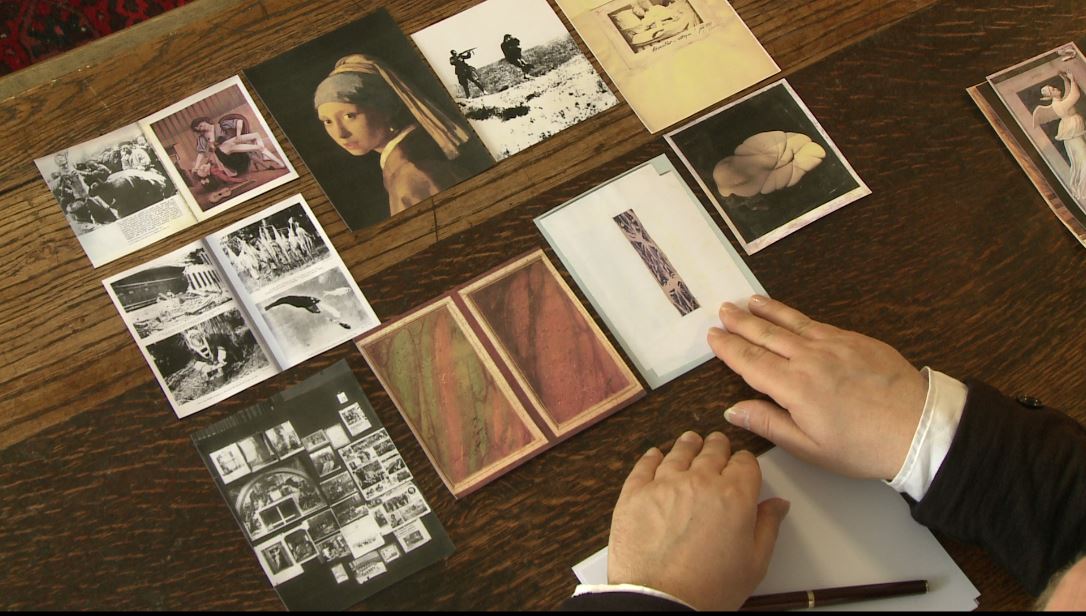
What you are invited to listen to is the discussion held after the screening of two documentary films portraying art historians Svetlana Alpers and Georges Didi-Huberman. These documentaries are part of a series of fifteen films entitled Un œil, une histoire and directed by Marianne Alphant & Pascale Bouhénic since 2012. This series brings art historians into focus, as they might not be familiar to most audiences, not even to intellectuals at large, offering a sensitive approach to their knowledge, intuitions and life journey. It comprises portraits of Michael Fried, Rosalind Krauss, Michel Thévoz, Gilles A. Tiberghien, Carlo Ginzburg, Philippe-Alain Michaud, Elisabeth Lebovici … And we are pleased to announce that a new film with the late Hubert Damish is to be released. Conscious of the strong Warburgian influence in some of these films, SensoProjekt presented these to Professor Bill Sherman, director of the Warburg Institute in London, who suggested to design a screening program in collaboration with two of the Warburg’s regular academic partners: the Courtauld Institute of Art (through Alixe Bovey, Head of Research and Senior lecturer) as well as Birkbeck College’s Art History Department (thanks to Leslie Topp, Head of the Department). And the idea arose of gathering three younger art historians, each one belonging to one of these institutions, to discuss the films and the topics. So we were very happy to hear the voices of Steffen Haug, Mara Polgovsky Ezcurra and Boris Cuckovic. Steffen Haug, art historian and philosopher wrote a dissertation about « The denial of images in the work of Alfredo Jaar » and earned his PhD from Humboldt University, Berlin, on « Walter Benjamin’s studies on mass images ». Since 2017, he is recipient of the Francis A. Yates long-term Fellowship at the Warburg Institute (London), where he pursues his studies about the relation between Warburg’s art historical research and the political events of the First World War. Mara Polgovsky Ezcurra, joined the History of Art Department at Birkbeck College in 2018, after having completed a Junior Fellowship at Queen’s College in Cambridge. Before that, she studied political and cultural history in Mexico and at Harvard University, and completed a MA at EHESS in Paris. Her research has focused on contemporary Latin American art and intellectual history. Her topics cover the politics of aesthetics, the study of life embodiment and presentness interactivity as well as agency in artistic practice. It includes ecological, cybernetic, multi-species art. She just received the Art Journal Award 2018, delivered by the College Art Association (USA). Boris Cuckovic, holds a degree in Art History and Information from Zagreb, Leiden and Amsterdam Universities. He is now associate lecturer at the Courtauld Institute, teaching courses related to Media practices of contemporary art, Cold War period, criticism and theory as well as current methodologies of art history. He is presently working on a PhD focusing on « The increased attention to the materiality of digital production in recent practice ». He particularly investigates how the historical experience of 2008 financial crisis affects the shifting cultural meaning of the digital image in this period, and its open source access. Each one of them gave a substantial critic of the films, their modality as well as their content. The juxtaposition of Svetlana Alpers’ current thinking next to Didi-Huberman’s images analysis was noticed as quite relevant, as both visions are necessary to art history. Besides, this material gave rise to the highly discussed future of art history. Strong argumentsin favor of the discipline, prospecting vues and brilliant warnings have all been expressed, also thanks to the questions of the public and the nice mediation of Leslie Topp. A few excerpts from the discussion : « It is very convincing… In these twelve images, they sum up their research. It is not their mode of working but their mode of looking back and the re-telling of their books, their research and their questions… The difference would be of course that in research, there will be a multiplicity of images and to sum it up into twelve images is a little bit like the notion of the masterwork… But if you have to do with media images and with mass images, then the plurality is what defines them … and you will need to relate to art images and to non art images. » (St. Haug) « Because I work with time-based media, I use a lot of documents, to give access to the perfomances I look at, so I always have to ask ‘how is acting on my perception of the performance’. But that applies to the painting as well. When I look at a painting, how is the brightness of it acting on me ? (…) {It all relies} on matter and materiality and their difference, materiality being the manipulation of matter. So the new question is ‘who is manipulating it and how’. What are the origins of whatever makes a work of art, who made it, as it is necessary to take into account a social history of art and to take into account the agency of the objetcs. » (M.Polgovsky Ezcurra) « The materiality of images needs to be reinvented again and again. In my context of digital production, there is a very strong gap between art historical methods and understandings or conceptualisation of materials, and what the artists are dealing with. However it is not necessarily the case. But there is some kind of taboo there. If an artist works with codes, this is somehow impenetrable to the art historian because it is not visual… So it is very much about developing the apparatus through which art historians can talk about materiality because all these images are produced somewhere … But the role of the visual and the role of the images need to be rearticulated. » (B. Cuckovic) With many thanks also to Michael Temple and Matthew Anthony Barrington from the BIMI, to Mélanie Gerin and Paul Rozenberg from Zadig Productions, and to Doriane films.